

The primary functional objective of cervical immobilization is to limit movement of the neck during extrication and transport. Paramedics apply a collar to reduce flexion, extension, and lateral bending while moving a patient from a vehicle to a stretcher. The device serves as one part of a broader spinal motion restriction protocol. It does not act alone.
Clinicians must recognize an important caution. Extrication collars can produce abnormal separation between vertebrae when a dissociative injury is present. This separation occurs because the collar pushes against the mandible and occiput, distracting the spine rather than stabilizing it. Device selection and application technique therefore matter greatly. A poorly fitted collar may worsen alignment. Proper sizing and careful placement help mitigate this risk.
This article evaluates Extrication Collars against four prescription criteria. Technical performance covers motion restriction and imaging access. Application fit addresses donning speed, sizing, and patient comfort. Regulatory compliance examines clearance and documentation for prehospital use. Cost considers unit price and lifecycle value.
These four criteria provide a consistent framework for comparison across collar types. Each criterion carries different weight depending on the clinical scenario and the service's protocol. A rural EMS agency may prioritize cost and one-person application. A high-volume trauma center may emphasize imaging compatibility and motion restriction data. The sections that follow apply these criteria to soft foam, Philadelphia-style, NecLok-style, and other rigid designs.
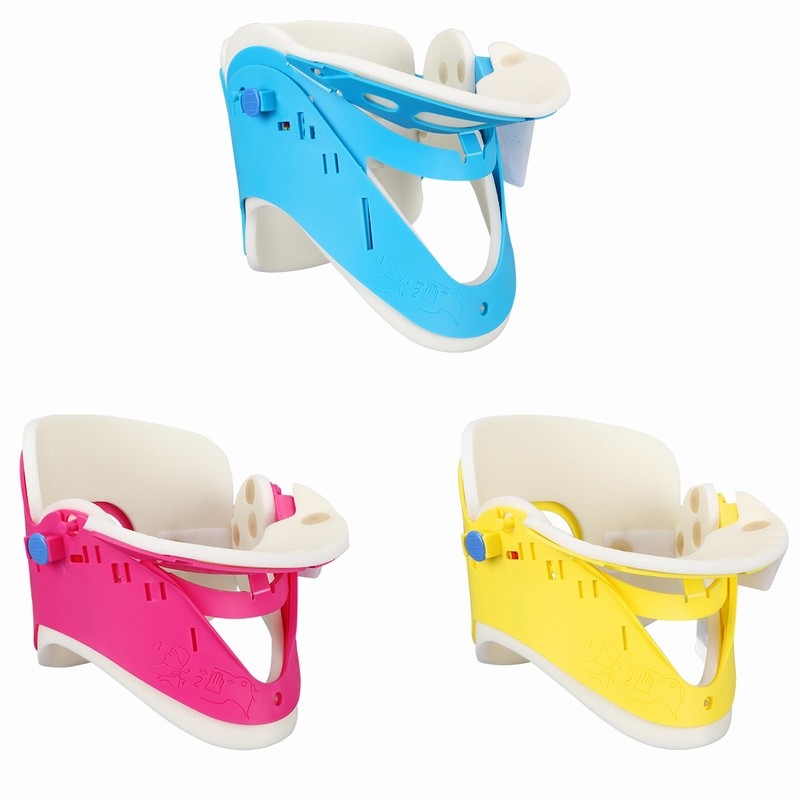
The market offers several distinct collar families. Soft foam collars use pliable padding. Philadelphia-style collars combine a rigid plastic frame with foam lining. The Philadelphia Red EM with Immobilizer adds a removable immobilizer block. NecLok-style collars feature a rigid, multi-piece structure. Vacuum splint cervical collars conform to the patient through air evacuation. Each family occupies a different position on the spectrum between comfort and motion restriction.
The Rosen et al. 1992 study compared the Nec-Loc Extrication Collar, the Philadelphia Collar, the Philadelphia Red EM Collar with Immobilizer, and the Vacuum Splint Cervical Collar. That work provides a direct benchmark across these rigid and semi-rigid designs. The Kaufman et al. 1985 study took a different approach. It compared three prefabricated cervical collars and used the soft foam collar and the Philadelphia collar as internal comparison criteria. Together, these two studies frame the design trade-offs that paramedics encounter in the field.
Soft foam collars prioritize patient comfort. A review published on the National Library of Medicine's PMC database reports that soft collars significantly decreased all head and neck motion (p<0.01). Flexion saw the greatest restriction at 39 percent, while lateral rotation saw the least at 11 percent. The same review notes that patient comfort is a critical factor, which encourages caregivers to give preference to soft collars in prescriptions.
The Kaufman et al. 1985 study, published in the Orthotics and Prosthetics library, quantified this further. The soft foam collar restricted axial rotation by 15.92 percent, anterior/posterior motion by 9.88 percent, and lateral flexion by 14.10 percent. The soft foam collar did not display a significant difference from the no-treatment mode in anterior/posterior motion. Its major effectiveness derives from kinesthetic reminder capabilities. Soft foam collars fit best in comfort-focused applications and low-acuity transport, where a proprioceptive reminder to limit movement serves the clinical goal.
Rigid collars deliver substantially more immobilization. The PMC review found that rigid collars caused maximum immobilization in flexion at 59 percent and minimum immobilization in lateral rotation at 18 percent. Rigid collars limited all motion much more than the soft collar.
The Kaufman et al. 1985 data show the gradation across rigid designs. The Philadelphia collar restricted axial rotation by 29.9 percent, anterior/posterior motion by 46.78 percent, and lateral flexion by 25.50 percent. The NecLok collar restricted axial rotation by 62.7 percent, anterior/posterior motion by 62.76 percent, and lateral flexion by 43.30 percent. All subjects perceived the NecLok to feel more restrictive than the other two collars and claimed it was less comfortable than the Philadelphia collar, yet not uncomfortable to wear. The Orthotics and Prosthetics library presents these results in the chart below.
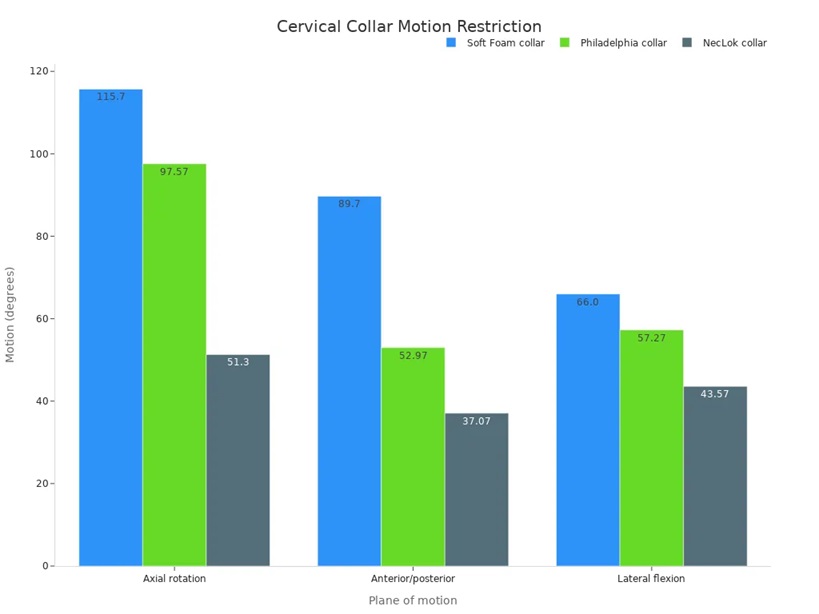
These findings show where each rigid design fits. Philadelphia-style collars suit general trauma immobilization with a balance of restriction and comfort. NecLok-style collars fit high-restriction scenarios. Vacuum splint cervical collars and the Philadelphia Red EM with Immobilizer serve specialized extrication needs. Adjustable extrication collars add sizing flexibility across these families. No single design wins every scenario; the clinical context determines the best fit.
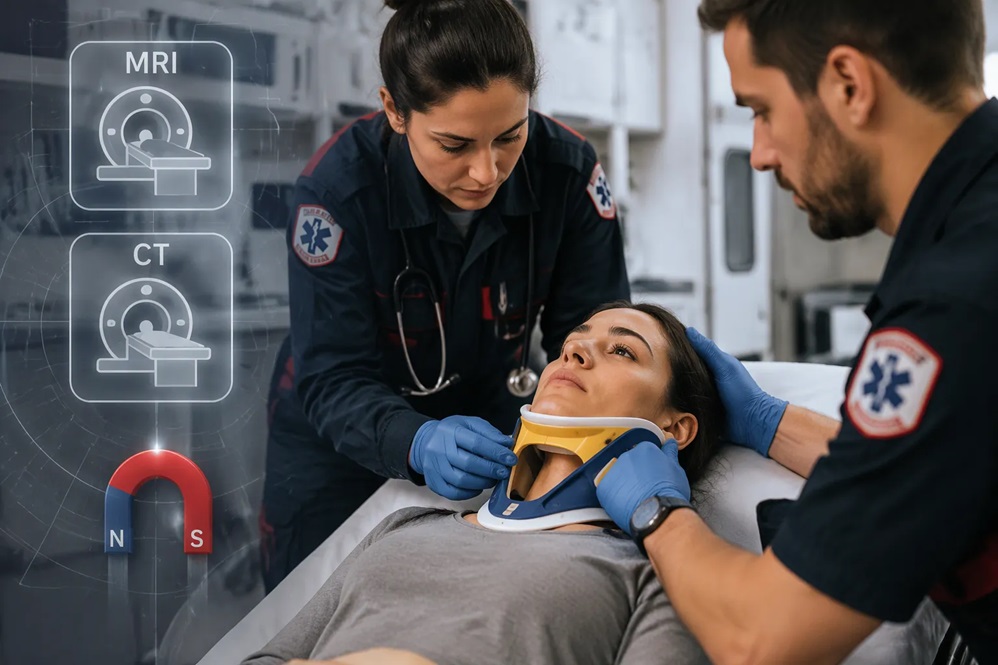
Field research confirms that collar choice changes real-world movement. In one assisted extrication study, EMS crews applied a cervical collar to some patients, and those patients showed significantly less flexion/extension in the sagittal plane and lateral flexion in the frontal plane during the procedure. The collar therefore contributes measurable restraint when crews move a patient from a vehicle to a stretcher.
Objective measures sharpen this picture. The PMC review reports that rigid collars limited flexion by 59 percent and lateral rotation by 18 percent. Soft collars restricted flexion by 39 percent and lateral rotation by 11 percent. Total movement data from the Rosen et al. 1992 study add another layer of comparison across the Nec-Lok, Philadelphia, Philadelphia Red EM with Immobilizer, and vacuum splint designs.
Paramedics should read these percentages as relative guidance, not absolute guarantees. The collar works alongside manual stabilization and careful log-rolling. A high-restriction model helps most when the crew also follows proper technique. Services comparing Extrication Collars can set minimum motion restriction targets in their protocols and verify them against published data.
Imaging compatibility affects downstream care. A PubMed-indexed study evaluated nine cervical spine braces and orthoses for MR imaging compatibility, including the EXO cervical collar and the Philadelphia collar. The findings give purchasers clear guidance:
These results matter for adjustable extrication collars and fixed designs alike. A collar that blocks imaging delays diagnosis and adds cost to the episode of care. Crews should remove the extrication cervical collar as soon as the trauma team clears the spine. Purchasers should confirm MR and CT compatibility before stocking any model.
Procurement teams can ask suppliers for imaging test documentation. That step protects patients and keeps radiology workflows moving.
Speed matters during extrication. A crew may need to apply a collar while the patient remains seated in a vehicle. Research on self-extrication offers a striking finding here. Patients who received an in-car collar application combined with self-extrication showed 9.5 mm of total movement. Patients who self-extricated without a collar showed 9.4 mm. The difference is negligible. This result suggests that a hastily applied collar during self-extrication adds little measurable restraint. Paramedics should weigh the time cost of donning against the actual benefit in this scenario.
One-person application shapes donning speed in practice. Many Extrication Collars now feature front-opening designs, hook-and-loop closures, and color-coded sizing. These features let a single paramedic size and secure the device without a second set of hands. Adjustable extrication collars add further flexibility, because one stock unit can fit a broader range of neck circumferences. Services that staff two-person crews may still prefer traditional designs, while solo responders often benefit from tool-free adjustment.
Proper fit determines both immobilization quality and patient tolerance. An extrication cervical collar must sit with the chin piece supporting the mandible and the occipital piece cradling the skull base. Oversized collars allow the head to shift. Undersized collars press against the jaw and cause pain. Adjustable extrication collars reduce sizing errors by letting the paramedic dial the height to the patient.
Comfort during transport affects compliance and anxiety. The Kaufman et al. 1985 study found that subjects rated the NecLok collar as more restrictive than the Philadelphia collar, yet not uncomfortable to wear. That balance matters on long transports. Soft foam collars favor comfort, while rigid designs favor restriction. Paramedics should reassess fit after loading the patient, because movement onto the stretcher can shift the device. A quick check of chin position and strap tension protects both alignment and patient comfort.
Regulatory compliance determines whether a service can legally stock and deploy a collar. Buyers should verify the documentation trail before purchase. The jiekangmedical.com resource outlines the key distinctions clearly:
These terms are not interchangeable. A supplier may hold ISO 13485 and CE marking, as Thuasne Group and BHW Medical document, while another holds FDA registration alongside ISO 13485, as Bird & Cronin reports. Each extrication cervical collar in a service's inventory should carry a clear document file. Procurement teams should archive the declaration of conformity, labeling, and quality certificates for every model, including adjustable extrication collars.
Evolving evidence also reshapes procurement at the system level. Australian statewide EMS services transitioned from semi-rigid to soft collars, a shift driven by emerging research on collar benefits and harms. That example shows how published evidence can redirect an entire inventory strategy.
Unit price tells only part of the cost story. Purchasers should weigh price against lifecycle factors: how many sizes a single unit replaces, how long the closure systems last, and how easily crews clean the surfaces between patients. Adjustable extrication collars can reduce stock-keeping complexity because one model covers a broader fit range, which lowers inventory carrying costs.
Soft foam collars typically carry lower unit prices, while rigid and NecLok-style designs cost more per unit. Neither figure alone proves value. A high-volume service may find that durable rigid Extrication Collars outlast cheaper alternatives across years of use. A low-acuity transport service may find soft collars deliver adequate function at lower total spend. Matching cost to call volume and protocol gives the clearest value picture.
The evidence points to a clear division of labor. Soft foam collars serve comfort-focused, low-acuity cases. The AOFitMed resource lists mild neck stiffness, muscle spasms, minor strains, mild whiplash without neurological red flags, and late-stage recovery support as appropriate uses. Dattmedi adds neck pain from poor posture, early whiplash recovery, minor cervical trauma, and post-surgical support to that list. The same source draws a firm line:
For most everyday neck conditions — strain, stiffness, mild whiplash, and chronic disc or joint discomfort — a soft cervical collar is the appropriate choice. Rigid collars are typically reserved for more severe injuries where strict immobilization is medically necessary.
Dorrella notes that soft foam models also suit office workers, students, and long-distance drivers with cervical sub-health. Philadelphia-style collars fit general trauma immobilization. NecLok-style and vacuum splint designs fit high-restriction extrication. Adjustable extrication collars bridge these groups by covering a wider fit range with one stock unit.
Broader research complicates the picture. A PMC review found that six of nine eligible studies concluded spinal collars should not be used in prehospital trauma patients, and none reported benefits. The review also notes that cervical collars showed no benefit in restricting movement using either vacuum mattress or spine board techniques. Paramedics should treat this as context, not a verdict. Protocols still require immobilization in many services, and the collar remains one tool within a wider spine care strategy.
Purchasers can translate these findings into a mixed inventory. A service might stock soft foam collars for low-acuity transport and clinic use, Philadelphia-style collars for general trauma calls, and NecLok-style or adjustable extrication collars for high-restriction extrication. That mix matches device to scenario and avoids over-specifying every call.
Tianzuo Medical supplies multiple collar types and can help services match selection to protocol and budget. A manufacturer partner with a broad catalog lets a procurement team compare Extrication Collars under one quality system and one document trail. Services should review call volume, protocol requirements, and imaging access before finalizing any order.
The comparison shows clear trade-offs across technical performance, application fit, regulatory compliance, and cost. Soft foam collars favor comfort in low-acuity transport. Philadelphia-style collars balance restriction and tolerance for general trauma. NecLok-style designs deliver high restriction for demanding extrication. No single model wins every call.
The best extrication cervical collar depends on the scenario, the protocol, and the budget. Paramedics should match the device to the call, and purchasers should stock a mix that covers low- and high-acuity needs. Adjustable extrication collars can simplify that inventory. Tianzuo Medical supplies multiple Extrication Collars types and helps services align selection with protocol and budget.
The Kaufman et al. 1985 data show the NecLok collar restricted axial rotation by 62.7 percent and anterior/posterior motion by 62.76 percent. Philadelphia-style collars restricted those planes less. NecLok-style designs therefore suit high-restriction extrication, while soft foam models serve comfort-focused transport.
One adjustable extrication collar can cover a broader range of neck circumferences than a fixed-size unit. That flexibility reduces sizing errors at the roadside and lowers stock-keeping complexity. Services still verify fit against their protocol, because chin support and occipital contact determine immobilization quality more than the size label alone.
Research on self-extrication found 9.5 mm of total movement with an in-car collar application, compared with 9.4 mm without a collar. The difference is negligible. Paramedics should weigh donning time against measured benefit and follow local spinal motion restriction guidance.
Buyers should request the EU Declaration of Conformity and CE marking for European use, plus the correct FDA pathway records for the United States. ISO 13485 confirms quality management, not product performance. An FDA establishment registration alone does not mean a device is cleared or approved.
Australian statewide EMS services moved from semi-rigid to soft collars as evidence on collar benefits and harms evolved. A PMC review found most eligible studies concluded spinal collars should not be used in prehospital trauma patients. Services should treat this as context when reviewing protocols and inventory.

 IPv6 network supported


 English
 فارسی
 français
 Deutsch
 русский
 italiano
 español
 português
 العربية
 Türkçe