

Treat the cervical collar as a deliberate clinical decision. Examination findings and validated tools such as the nexus criteria and the canadian c-spine rule guide whether spinal immobilization is warranted, not routine reflex.
A cervical collar is indicated for patients with a known or suspected spinal cord injury. The device achieves spinal immobilization while clinicians assess the patient. It also applies to patients with abnormal radiographs, an abnormal clinical examination, or both. The goals of cervical spine immobilization are straightforward: minimize movement, maintain neutral alignment, and limit flexion, extension, and rotation. A correctly fitted device supports each goal. Clinicians should weigh the indications for spinal immobilization against the patient's overall condition before placing any device.
Altered mental status is a strong driver of clinical suspicion for spinal injury. The Pediatric Emergency Care Applied Research Network identified eight factors highly associated with cervical spine injury in children aged 0 to 16 years, and altered mental status was one of them. The same review reports that cervical spine injury occurs in 3.7% of polytrauma patients overall, about 3% of alert patients, and 8% of unconscious or obtunded patients. That rise matters. A patient who cannot participate in an examination is high-risk, and a rigid cervical collar remains clinically defensible until clinicians exclude an unstable cervical spine injury.
Selective spinal motion restriction may be considered for trauma patients with depressed consciousness, an inability to participate in examination, overt neurological deficit, direct spinal pain, deformity of the spine, or a concerning missile or stab trajectory. Collar placement should never supersede airway management, hemorrhage control, resuscitation, or rapid transfer to definitive care. In isolated penetrating trauma, routine collaring should give way to context-dependent motion restriction. Unstable cervical injury is uncommon in that setting, and EAST guidance recommends against routine immobilization in adult penetrating trauma. When a team does choose to immobilize a penetrating-trauma patient, an extrication cervical collar can support rapid, controlled transfer.
Neck pain, focal neurologic deficits, and distracting injuries each raise concern. Midline tenderness, altered level of consciousness, intoxication, or a distracting injury each constitutes a nexus criteria failure, and imaging is required before collar clearance. Neurologic deficits require MRI even when CT is normal, because ligamentous or spinal cord injury may still be present. Intoxication and distracting injuries can mask pain and lead to premature collar removal, so caution is required.
The numbers support this caution. Neck discomfort carries 86% sensitivity, and neck tenderness carries 79% sensitivity. A positive physical exam combining neurologic deficits with cervical discomfort or tenderness reaches 93% sensitivity and 16% specificity. A normal examination, by contrast, carries a negative predictive value of 98.7%. Diaz and colleagues compared CT with five-view plain films in 1,006 patients, including 172 with altered mental status or distracting injuries. CT reached 97.4% sensitivity versus 44% for plain films, with 100% specificity for both. Tianzuo Medical supports evidence-based, protocol-driven immobilization practice, including adjustable extrication collars for services that stock them.
After trauma, a child with neck pain should have a cervical collar placed for immobilization. The same applies when other criteria for spinal immobilization are met. The 2018 ACS-COT/ACEP/NAEMSP consensus statement endorses several pediatric predictors of cervical spine injury after blunt trauma:
These predictors lack prospective validation. Providers should apply them alongside local protocols, history, and physical examination, and keep a high index of suspicion. Fit matters too. A correctly sized collar with neutral anatomic alignment protects the child; a loose or oversized device does not.
Adult decision rules do not transfer cleanly. The original NEXUS study enrolled only 2.5% of patients aged 8 years or younger, including 1.3% of its cervical spine injury cases, and every Canadian C-Spine Rule patient was older than 16 years. Neither study could draw conclusions about children.
A multicenter prospective pediatric trial of 3,065 patients tested NEXUS criteria and found 100% sensitivity and a 100% negative predictive value. All 30 children with cervical spine injury had at least one risk factor, and no child without a risk factor had an injury. The authors cautiously endorsed the criteria for children aged 0 to 9 years. Clinical clearance criteria generally apply to children older than 2 years, with added caution in younger patients.
Pediatric assessment demands age-appropriate judgment and adherence to local protocols. Pediatric cervical spine injuries are uncommon, yet pediatric spinal injuries carry high stakes, and pediatric patients in pediatric blunt trauma pathways deserve the same disciplined reasoning applied to adults. Pediatric blunt trauma teams should document the exam, the decision, and the rationale. Pediatric blunt trauma protocols vary by institution, so confirm local guidance before clearance.
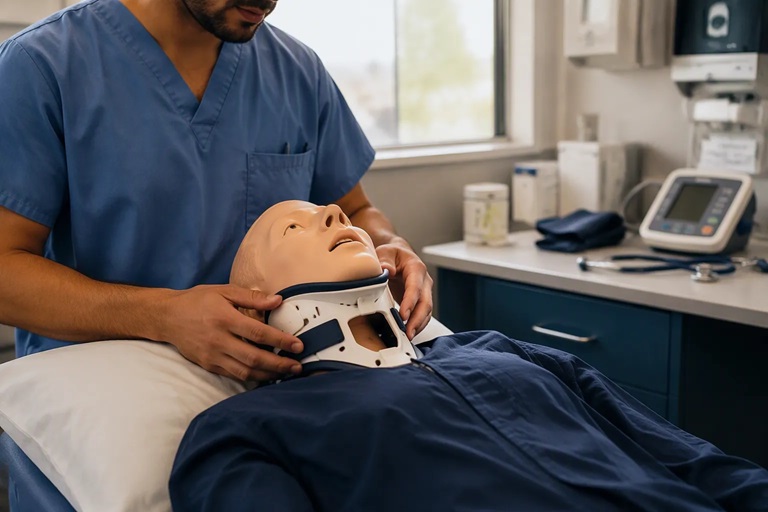
Routine collar use for every trauma patient does not hold up. Many patients arrive with mild injuries or a single mechanism that poses little threat to the neck. A careful examination and a validated decision rule can clear these patients without a device. When the workup confirms a low-risk presentation, the collar comes off or never goes on.
Spinal immobilization means the use of adjuncts such as a cervical collar or a long board to minimize movement. Each adjunct carries its own risks. A board presses on the skin and restricts breathing. A hard collar traps heat, limits jaw movement, and complicates airway access. These tools help specific patients. Used without indication, they add cost and harm while offering little protection.
A patient who meets every low-risk criterion needs no collar. Clinicians can walk through the following checklist in order:
Normal mental status with no change in alertness
No age or developmental concerns
Normal neurologic examination
No tenderness on palpation of the cervical spine or soft tissues
No pain with active range of motion of the neck
No distracting injuries
A mechanism of injury unlikely to cause cervical spine injury
A negative examination across all seven points means radiographic studies may not be needed, and the collar may be removed. A second common standard asks whether the patient is awake and alert with a GCS of 15, meets the nexus criteria, and can flex, extend, and rotate the neck 45 degrees to both sides without pain. A patient who passes these checks is a candidate for collar removal.
The reverse list matters just as much. Clinicians should apply a collar when a patient shows an altered level of consciousness, drug or alcohol intoxication, an inability to communicate, spinal column pain or tenderness, neurologic complaints such as numbness or motor weakness, anatomic deformity of the spine, or a distracting injury. Severe thoracic trauma, long bone fractures, crush injuries, and large burns all count as distracting injuries.
Validated tools support this selective approach. The canadian c-spine rule and similar instruments identify patients at low risk for spinal injury. Those patients become candidates for skipping the collar altogether. The decision belongs to the clinician, and the documentation should reflect the reasoning.
The overuse problem is well documented. Cervical collars were unnecessary and overused in most trauma patients who lacked multiple traumas or who had only mild injuries. Nearly 43% of trauma patients did not require a cervical collar, yet clinicians still prescribed one, adding unnecessary costs and raising complication risk. Collars caused problems and injuries in more than 40% of trauma patients. Their use is frequently unnecessary or even harmful.
The physical limits of the device deserve attention. A collar only partially restricts neck movement, reducing range of motion by about 53 degrees, and it cannot completely immobilize the neck. Spinal cord injury prevalence in trauma patients is low, which makes routine use controversial. Cadaveric studies show that considerable force is required to fracture the spine. Low-energy forces from a patient moving the neck are unlikely to cause additional spinal cord injury. An unstable fracture without already devastating neurologic injury is rare.
Comparative research raises further questions. A retrospective study compared neurologic outcomes between the USA, where routine collar immobilization is common, and Malaysia, where routine immobilization is not practiced. The unimmobilized group showed less neurologic disability. That research is imperfect, yet it does not favor an absolute benefit of routine collar use.
The pediatric picture adds its own caution. Children with suspected cervical spine injury immobilized through movement minimization reported higher pain scores than non-immobilized children (OR = 2.2; 95% CI 1.4–3.4; p<0.05). They were also more likely to undergo cervical radiography (56.6% vs 13.4%; p<0.0001) and to be admitted (41.6% vs 14.3%; p<0.05). In lightweight motorcycle injuries with cervical spine injury, immobilized patients had longer ICU stays than non-immobilized patients (7.54 ±7.93 vs 2.33 ±1.63 days; p=0.002), though total hospital stay did not differ significantly (p=0.154). Hospital mortality showed no significant difference between full immobilization and movement minimization (19.5% vs 9.7%; adjusted OR = 0.56, 95% CI 0.24–1.30; p=0.18).
|
Complication |
Patients Most at Risk |
Clinical Implication |
|---|---|---|
|
Pressure injury (pooled prevalence ~7% with prolonged hard-collar use) |
ICU, sedated, or ventilated patients; older adults; poor perfusion; limited communication |
Skin breakdown, pain, infection risk, delayed mobilization |
|
Dysphagia or aspiration risk |
Older adults, frail patients, TBI or cervical spine injury |
Aspiration, poor oral intake, pneumonia, delayed rehabilitation |
|
Respiratory compromise |
Frail older adults, limited pulmonary reserve, TBI, cervical spinal cord injury |
Respiratory failure, impaired secretion clearance, delayed mobilization |
|
Raised intracranial pressure concern |
TBI or reduced intracranial compliance |
Potential worsening of intracranial physiology |
|
Difficult airway access |
Patients needing urgent intubation or operative transfer |
More difficult or delayed airway management |
|
Pain, discomfort, delirium, immobility |
Frail older adults, cognitively impaired, prolonged collar use |
Poor adherence, delirium, reduced mobility, lower rehabilitation participation |
Continued immobilization should be reassessed when harms begin to outweigh expected benefit. Dysphagia, pressure injury, delirium or frailty burden, raised intracranial pressure concerns, poor adherence, and limited functional benefit should prompt reconsideration of collar type, duration, or discontinuation.
The evidence points in one direction. A spinal immobilization collar is a clinical tool with a defined role, not a default step in trauma care. Reflexive use of a c-collar for every patient exposes people to pressure injury, breathing difficulty, and delayed care without proven benefit. Selective use guided by examination and decision rules serves patients better. That principle applies across spinal immobilization in trauma, from the field to the emergency department. Teams should reassess the device at every handoff and remove it as soon as the findings allow.
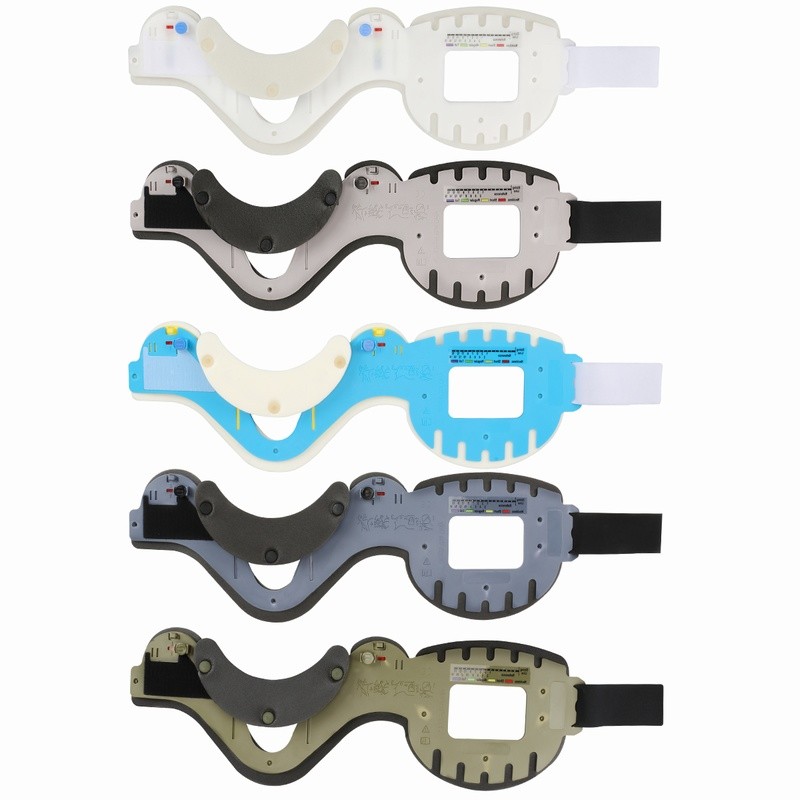
Validated tools help clinicians decide whether a collar is necessary. They reduce unnecessary immobilization and protect patients from devices they do not need. The cervical collar has been a hallmark of prehospital trauma care for decades. Current practice emphasizes selective use guided by evidence and protocols, and decision rules sit at the center of that shift.
The nexus criteria give clinicians five yes-or-no questions. A patient is NEXUS-negative only when all five are absent.
|
NEXUS Criterion |
Absent (0) |
Present (+1) |
|---|---|---|
|
Focal neurologic deficit |
No |
Yes |
|
Midline spinal tenderness |
No |
Yes |
|
Altered level of consciousness |
No |
Yes |
|
Intoxication |
No |
Yes |
|
Distracting injury |
No |
Yes |
Any single positive finding makes the patient NEXUS-positive, and imaging or collar use should be considered. A pooled analysis of 12 adult studies covering 55,565 patients found the nexus criteria reached 0.95 sensitivity and 0.41 specificity for clinically important cervical spine injury. Pediatric performance differs: five studies covering 4,757 patients reported 0.98 sensitivity and 0.37 specificity for any injury. The rule has limits. One trial found NEXUS sensitivity of 90.7% against 99.4% for the canadian c-spine rule, meaning NEXUS would miss roughly 1 in 10 clinically important cases in that population.
The canadian c-spine rule asks three questions in sequence. First, does the patient have a high-risk mechanism, such as a high-risk mvc with ejection or death at the scene? Second, does any low-risk feature permit safe range-of-motion testing? Third, can the patient rotate the neck 45 degrees both ways without pain? A negative screen supports collar removal without imaging.
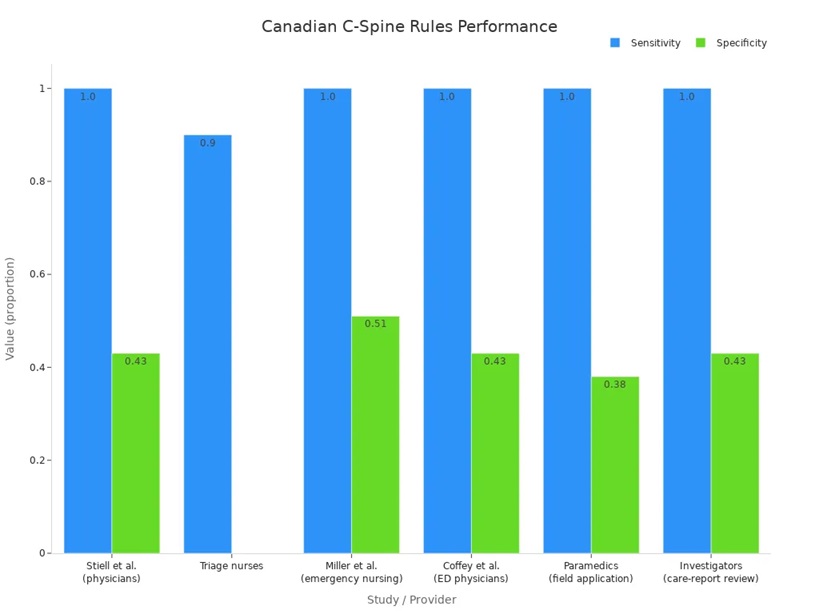
Performance is strong across providers. Physicians, triage nurses, emergency nursing staff, and paramedics all reported sensitivity of 0.90 to 1.00, and negative predictive value reached 100% in every reported application. The chart below shows the spread.
The direct comparison favors the rule on efficiency as well. The canadian c-spine rule cut imaging by 44% versus 36% for NEXUS in the only head-to-head trial. Average imaging reduction across studies was 42.0% versus 30.9%. False-negative rates ranged from 0% to 0.11% for the rule and 0% to 1.0% for NEXUS.
"In that study, the CCR was more sensitive (99.4% vs. 90.7%) and more specific (45.1% vs. 36.8%) than NEXUS, and the authors concluded that, for the alert-and-stable population both rules target, the CCR would have resulted in less radiography with fewer missed injuries."
For pediatric patients, the PECARN rule identifies altered mental status, neck pain, neurologic symptoms, and significant head or torso injury as key signs. EMS systems should retire mechanism-based protocols and adopt assessment-focused tools. The E.M.S. IMMO Protocol offers one adult option, and services that stock adjustable extrication collars can pair selective decisions with properly fitted equipment. Appropriate use of spinal immobilization depends on this discipline. Cervical spinal immobilization protects the right patient, and spinal immobilization in trauma works best when a tool, not a habit, drives the choice.
A cervical collar presses on skin and soft tissue for hours. That pressure carries measurable consequences. Over 75% of adult trauma patients with an extrication collar developed a category 1 pressure ulcer, and the occiput was most affected because of high device-skin interface pressure. Roughly 65% of patients developed indentation marks, with 28% rated severe. Risk factors include ICU stay, low consciousness, longer hospital stay, older age, cardiovascular or respiratory disease, and mechanical ventilation.
|
Reported Risk |
Evidence |
|---|---|
|
Pressure injuries |
Over 75% of adult trauma patients with an extrication collar developed a category 1 pressure ulcer |
|
Indentation marks |
About 65% of patients, with 28% severe |
|
Pain |
Over 60% experienced pain, 38.5% severe |
In a qualitative study of adult blunt trauma victims with cervical collars for potential spinal cord injury, 38% reported discomfort from immobilization (mainly point pressure at the posterior head and hip), and 24% experienced pain related to immobilization.
Airway access deserves equal attention. Spinal immobilization can complicate airway securing. Manual in-line stabilization may worsen the laryngoscopic view and may increase subluxation at unstable segments. Clinicians should open the collar to examine the neck for crepitus, hematoma, or laceration, since any of these can compromise the airway and may hide beneath the device.
Traditional rigid immobilization rested on a theoretical concern: post-injury movement could cause delayed neurologic deterioration. That concern lacks supporting evidence. No study shows that movement after injury leads to delayed neurologic worsening. Meanwhile, prolonged collar use is linked to pressure injuries and other complications, and out-of-hospital protocols increasingly avoid extended collar time for this reason.
The Eastern Association for the Surgery of Trauma systematic review supports collar removal after a negative high-quality CT in obtunded adults. Extended immobilization adds downstream harm without added benefit. The net balance favors selective spinal motion restriction and earlier collar removal. Tianzuo Medical is committed to evidence-based immobilization products and clinician education. Judicious use, not routine use, is the standard for every patient, including pediatric cases where a collar is indicated.
A spinal immobilization collar is indicated for known or suspected spinal cord injury, altered mental status, neck pain or tenderness, focal neurologic deficits, distracting injuries, penetrating trauma with neurologic complaints, and pediatric neck pain after trauma. Clinicians should let the nexus criteria, the canadian c-spine rule, and local protocols guide the decision. Both rules carry high sensitivity, so a negative screen supports clearance. Judicious spinal immobilization, not routine use, is the standard. Tianzuo Medical remains committed to evidence-based immobilization products and clinician education, including pediatric sizing guidance for every cervical collar it supplies.
No. Clinicians place a collar only when examination findings or a decision rule support it. A patient who is alert, sober, free of midline tenderness, and without neurologic deficit or distracting injury can often skip spinal immobilization entirely. Reflexive collaring exposes low-risk patients to pressure injury and discomfort without proven benefit.
Five findings drive the decision. These include altered mental status, midline spinal tenderness, focal neurologic deficit, intoxication, and a distracting injury. Any single positive finding supports spinal immobilization until clinicians exclude an unstable injury. Penetrating trauma to the head, neck, or torso with neurologic complaints also warrants consideration of spinal immobilization.
The nexus criteria ask five yes-or-no questions, and any positive answer blocks clearance. The canadian c-spine rule screens for high-risk mechanism first, then permits range-of-motion testing. One head-to-head trial found the rule more sensitive than the nexus criteria (99.4% versus 90.7%). Both tools support selective spinal immobilization rather than routine use.
A child with neck pain after trauma should receive a collar for spinal immobilization. The same applies when other criteria are met, such as altered mental status, focal deficits, or a high-risk mechanism. Pediatric assessment requires age-appropriate judgment, and adult rules do not transfer cleanly to young children.
Fit matters at every age. A loose or oversized device fails to hold neutral alignment, and a tight one adds pressure risk. Services that stock an extrication cervical collar or adjustable extrication collars can match device size to the patient. Proper fit supports the goals of spinal immobilization: limited flexion, extension, and rotation.

 IPv6 network supported


 English
 فارسی
 français
 Deutsch
 русский
 italiano
 español
 português
 العربية
 Türkçe